willingnness to pay, and how it fits into a benefit function
the value of a lost load:
---> what is a "lost load"?
estimate of willingnesss to pay that replaces the “top” part of the demand curve
bounds the benefit function
values and prices load shedding
linear demand, q=A−5p, calibrated to the Palliser blocks, for use when some price responsiveness of demand is wanted; often demand is instead fixed at a number
learning objectives:
identify decision variables, the objective function, and the constraints in a written description of a dispatch problem
explain the difference between a feasible solution and an optimal one and determine whether each constraint is either binding or slack at a given solution.
read this as: what is the general difference between a solution, and the best solution, and when it comes to the constraints on either of those, the measure of importance any of those constraints have on the (best) solution
solve a two generator dispatch problem graphically, and a five-genersator problem by cheapest-first reasoning, verifying optimality in written words
state the operational defintion of shadow price, and compute one by the perturb, resolve, difference method
read this as: the shadow price involves a realistic expectation for something that can go wrong (perturbation), and there is therefore a difference between the shadow price and the regular price
explain why a slack constraints shadow price is 0, and interpret the shadow price of a capacity constraint as a units operating margin
read this as: when there is something that has gone wrong (perturbation), the generator is going to be working only on the binding consraints: it is not going to spend money on inputs that can be cut, which are the slack constraints.
note. everything is done with one small problem from the Palliser system.
why optimization?
wholesale electricity market is a mechanism for solving a constrained cost-minimzation problem
every design feature we discuss one of three things:
objective
constraint
rule for turning the solution into prices and allocating resources
contraints will grow as we go through it: energy balance and capacity today
security constrained eocnomic dispatch (SCED), with locational marginal prices (LMP) as its pricing rule, is a particular version of this problem.
base assumptions.
one location. electricity moves freely.
one hour. solve a single hour on its own, no linking hours.
offers equal marginal cost. assume there is no market power
demand is fixed at the palliser MID block: 9,000MW, regadless of price.
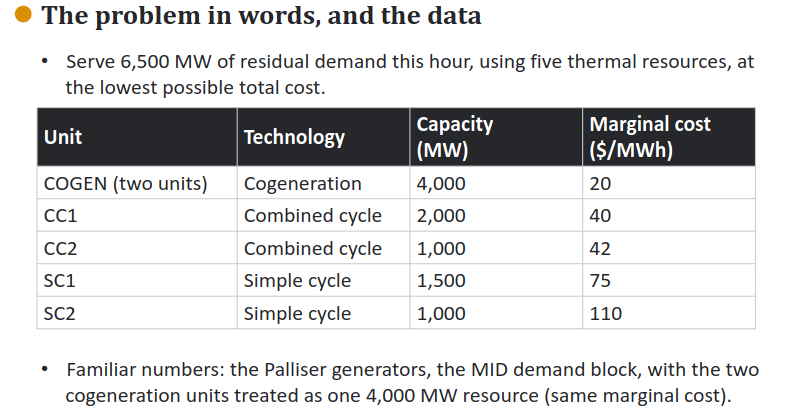
wind (1,500MW) and hydro (1,000MW) run whenever available at zero marginal cost, treat them as fixed and serve the remainder with the thermal units.
remaining (residual) demand for the thermal untis: 9,000-1,500-1,000=6,500 MW.
**overall:
not worried about the location or time, offer is equal to marginal cost because the market is perfectly competitive, the MID block is defined as 9,000 MW.
note. the MID block is assigned about 2-fifths of the entire year, accoutning for a medium amount of energy being demanded
the problem:
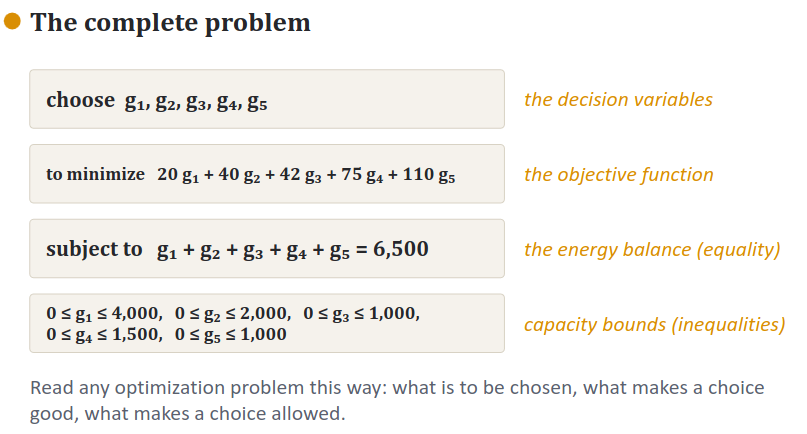
step 1, decision variables: how do we choose?
set gn as the amount that each unit generates in an hour
candidate solution is a list of 5 numbers that correspond to gn, 1≤n≤5: exercise is about choosing the best list
step 2: what make a solution good?
the objective function assigns a score to every candidate solution. ours is the total cost of generation this hour:
total cost = 20g1+40g2+42g3+75g4+110g5
we want to minimize this cost.
note. with a benefit function and an elastic demand, we would maximize surplus, which is defined to be benefit less cost, when load is fixed (as it is here), benefit is a constant and the two problems coincide.
because offer equals marginal cost by assumption, minimizing as-offered cost is equivalent to minimizing true cost. when we discuss market power, the same optimization minimizes as-offered cost only.
read this as: when we solve the cost-minimizing problem today, it will solve under the assumptions we have, but when we expand our constraints later, it will only slve one (unrealistic) problem.
step 3: constraints and the energy balance
note. constraints separate allowed solutions from disallowed ones.
generation must equal consumption (under our current assumptions)
note. there is a particularly important economic constraint: the shadow price will turn out to be the market price.
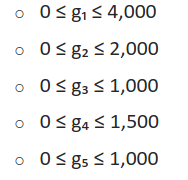
assumption: each unit is limited by its capacity, and cannot generate a negative amount:
may hold with room to spare, or exactly
a constraint that holds exactly at a solution is a binding one there; one with room to spare is slack.