introduction to electricity markets
~ markets as optimization systems ~
- questions:
- where does power come from?
- who decided, and when, which generators in alberta would be running at this minute?
- what did the last megawatt hour cost ot produce? what was it sold for? what are the reasons for differentiation at two different points in time?
- why study electircity markets?
- ‘essential intermediate good’
- quanitites balanced every second
- prices computed on minute scale
- optimization across a variety of periods
- extremely complex economic ecosystem
- unusual economics
- limited storage at scale
- demand barely responds to price
- power system reliability is a public god (non rivalrous and non-excludable)
- flows on power networks governed by physics rather than contracts or policy
- alberta; energy only market since 2001, subject to continuous evolution
- REM: restructured energy market
- chnages how alberta dispatches and prices power
- modern electricity market: REM subset
- 'a wholesale electricity market is a decentralized mechanism for solving a constrained cost-minimization problem to efficiently allocate resources'
- ‘wholesale’-selling product in bulk to other businesses rather than to individual consumers
- ---> having electricity sold wholesale and the structure through which its sold allows for decentralization of a solution to a cost-minimation problem under specific constraints so that consumers can have an intermediate essential good that should be efficiently allocated
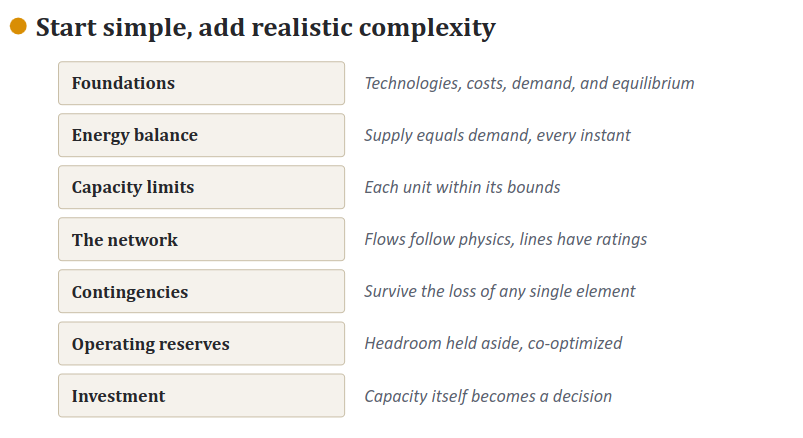
- market design feature will be one of three things:
- an objective
- a constraint
- rule for turning the solution into prices and allocating resources
- ‘essential intermediate good’
- the physical system
- generation: production of electricity
- hundreds of facilities in alberta
- transmission: high voltage grid moving bulk power across the province
- distribution: lower voltage wires reaching premises
- regulated monopolies by service territory
- retail: consumer interface with the market
- generation: production of electricity
- uniqueness of electricity
- limited storage at commericial scale: network downtime means balckout/brownouts
- ‘brownout’?
- how would a network go down?
- equilibirum reached by moving supply
- automated price responsiveness of demand and storage at scale makes this even more complex
- delivery follows physics, not contracts or policy
- location matters if the network is constrained
- physical mechanism versus societal construct — how does this change things?
- location matters if the network is constrained
- capital intensity and longevity:
- generators expensive and lumpy investments that last for decades
- today’s prices and expectations are revenue that underpin investment
- generators expensive and lumpy investments that last for decades
- limited storage at commericial scale: network downtime means balckout/brownouts
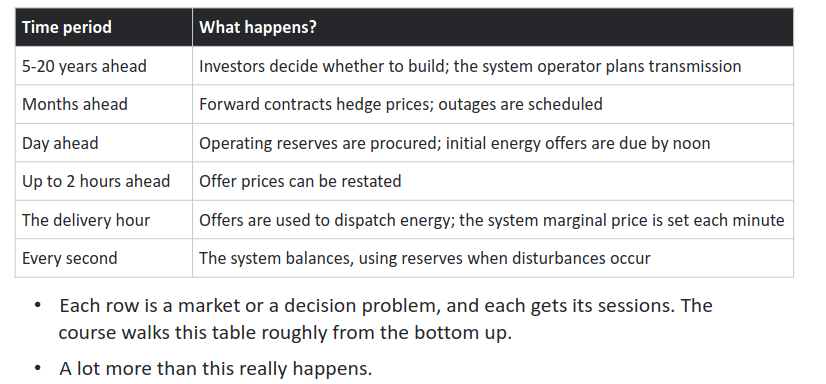
- timeline
- twenty years ago:
- system operator projects long term transmission plan over a twenty year horizon
- five to ten years ago:
- S.O applies to the regulator for a new transmission:
- generators begin considering new investment, approval and build times of one to ten years:
- investment case requires a forecast of energy market prices over time
- two to five years ago:
- construction begins on new generation and transmission:
- generators declare outages for maintenance:
- generators, large consumers, and retailers begin hedging in the forward market
- ‘forward market’: over the coutner financial marketplace, two parties agree to buy or sell and asset at a set price for delivery at a specific time
- ‘hedging’: taking financial action to protect against the risk of future price increases
- one day ahead:
- SO procures operating reserves for the following day: capacity held back from the energy market for contingencies and moment-to-moment balancing
- generators submit offers 999.99/MWh
- importers offer to bring power in with interconnections with BC, montana, SK: exporters bid to take the power out
- consumers can submit bids to reduce consumption at stated price, although this is rare
- all offers and bids are assembled into a merit order for each hour: the ordered supply curve this course studies
- merit order: feasibility? how realistic it is? what good it does?
- up to two hours ahead:
- generators can change (restate their offer prices)
- offers for the hour beginning at 6 pm are locked in at 4 pm
- ‘the hour beginning at 6 pm is known as the hour ending 19 (HE 19. this is because the hour ends at 7 pm, which is 19:00’
- what the fuck does this mean
- within two hours before delivery begins, quanities can change only for an acceptable operating reason, typically a chnage in the capability of the unit
- within the delivery hour
- SC (system controller) dispatches units up or down according to offers as demand changes
- SMP is the offer price of the last dispatched unit in each minute; as demand changes, the marginal unit and SMP change
- this will chnage substantially once alberta implements dispatch and pricing derived from optimization
- units ramp towards instructed level
- regulating reserve covers the small supply-demand imbalances that remain during ramping
- time-weighted average: TRA of the SMPs is the hourly pool price: an SMP of 90/MWh for forty minutes yields a pool price of $80/MWh.
- most consumers do not obersve the current price and do not respond to it: some large consumers do
- within the following one to six months
- financial settlement occurs for the delivery month: generators are paid, laqrge consumers and retailers pay
- most consumers instead pay rates negotiated with their retailers, which do not vary hour to hour
- market paritcipants are assessed for compliance with the rules and legislation
- subject to investigation and enforcement
- enforcement processes generally occur after the delivery hour, subject to statutory limitations periods
- twenty years ago:
- examples of market data:
- monthly average pool prices
- pool prices and temperature
- what the fuck is meant by temperature
- intermittency and the pool price over one week
- next day: