chapter one
- october alberta referendum
- five questions: five are non consitutional
- four questions about authority
- who may ask - can a province hold this referendum at all?
- who may decide - what does a result oblige anyone to do?
- who may amend - secession (leaving canada) needs a constitutional amendment
- who pays - what changes hands, and what does it cost?
- none of these are about whether separation is a good idea or not: it is about the fact that they need to be answered before the question can even be asked properly
- “before ervaluatign a proposal, you ahve to locate it”
- ‘defensible fiscal claim from an indefensible one’
- ‘people disagree about the scope of government because they hold different political philosophies’
- freedom versus well being of the community
- philosophy is not sufficient
- what do governments actually do?
- where does the legal power to conduct economic policy reside?
- how has it evolve over time?
- what does government spend money on, and how does it raise revenue?
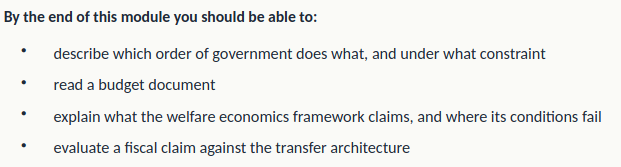
- ---> last one: ‘evaluate fiscal claim against the transfer architecture’
- guess: fiscal claim is a prescriptive claim about a certain policy, and we can evaluate it against how the government currently transfers money?
- key actors in fiscal decision making
- measures size of government: why population, inflation, and growth adjustments matter
- federal revenue sources and expenditure
- provincial revenue sources and expenditure
- municipal, territorial, and indigenious governments
- purpose and functioning of fiscal transfers
- ---> last one: ‘evaluate fiscal claim against the transfer architecture’
before the deal
- land was not empty
- treaties between colonizers and indig folx not the first: ‘Robinson treaties’ signed in 1850
- british columbia not covered by any historic treaties, a lot of quebec, and labrador, eastern arctic
- canada recognizes 70 historic treaties signed between 1701 and 1923
- both robinson treaties (there were two), increased annuities to $4 per person in 1875: they were never raised again even through a century of mining, forestry, and hydrodevelopment (slide 34, lecture notes, LIndsey Tedds)
- supreme court unanimously held that the crown had breached both treaties
- called the case Restoule, after lead plaintiff
- Robinson Huron settled for 10 billion, Robinson-Superior did not; crown offered settlement at 3.6 billion against a claim of 36 billion
- supreme court unanimously held that the crown had breached both treaties
- when the colonies came along, the treaty with the crown didn’t disappear: the agreement simply split into two
- section 91 (what is this) says which government (crown or colony) may legislate, nothign about what is owed
- grant of POWER
- section 109 sent land to the provinces (slide 41, lecture notes, LIndsey Tedds)
- benefit of the land went to the provinces, responsibility for the relationship went ot Ottawa, and ‘the promise bound the crown in both its rights’ ---> what does this mean?
- crown gets both the benefits of the land as well as power over the relationship?
- ‘these obligations do not sit inside of the revenue split: they sit across from it’
- ---> what does this mean?
- constitutional protection arrives in 1982 -- made the 174 year old promise enforcable
- benefit of the land went to the provinces, responsibility for the relationship went ot Ottawa, and ‘the promise bound the crown in both its rights’ ---> what does this mean?
- section 91 (what is this) says which government (crown or colony) may legislate, nothign about what is owed
- treaties between colonizers and indig folx not the first: ‘Robinson treaties’ signed in 1850
making the deal
-
before 1867
- crown administers several colonies across what we now know as canada, north of the united states
- atlantic: NS, NB, PEI, Newfoundland
- Province of Canada; today, southern ontario and quebec
- BC on the pacific coast
- between 1864, negotiated a federal union
- composed of province of canada, NS, and NB joined: the rest followed
- between 1864, negotiated a federal union
- we call it 'the deal'
- crown administers several colonies across what we now know as canada, north of the united states
-
bargain struck in 1867:
- colonies hand over theirmain revenue source; ottawa assumes debt and national responsibilities: provinces keep health care, education, and social services, with direct taxation only
-
where colonial money comes from
- what does it mean for a colony to hand over their main revenue source?
- custom duties on imports, and excise taxes
- excise tax: indirect tax charged by a government on the production, sale, or use of specific goods than on general retail sales
- not a preference; a constraint
- trade moved through a handful of ports, so it could be taxed by a smal administration
- income and property taxes need machinery that did not yet exist, across settlements that were scattered and poor
- trade moved through a handful of ports, so it could be taxed by a smal administration

- what does this figure mean?
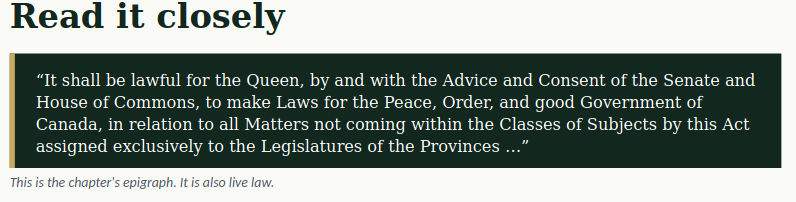
- three things are hiding in this sentence: what are they?
- guess:
- crown has power, being advised by the senate and house of commons, to pass laws
- but these laws may only concern the responsibility of the province of canada, so the provinces have to make the rest of the laws
-
- the crown cannot have sole control over the laws; they must act with the senate/house of commons. taxing and spending require legislation.
-
- there is a list: prvinical list exists without telling us what is on it
-
- ottawa gets the residual: “all matters not coming within”
- structural advantage
- guess:
- three things are hiding in this sentence: what are they?
- "peace, order, and good government"
- we call it POGG
- clause does not say only what the parliment may legislate: says what legislating is for
- ‘one sentence assigns the power, names who wields it, and declares what it is for’
- POGG is live law
- provinical list is section 92, federal one is 91
- 92 is a closed list, sixteen classes of subject
- section 91 has 29 classes, but also carries POGG
- POGG is live law
- “cannot know what is federal until you know what is provincial”
- custom duties on imports, and excise taxes
- what does it mean for a colony to hand over their main revenue source?
-
what is on each list
- federal:
- taxing power
- any mode or system of taxation
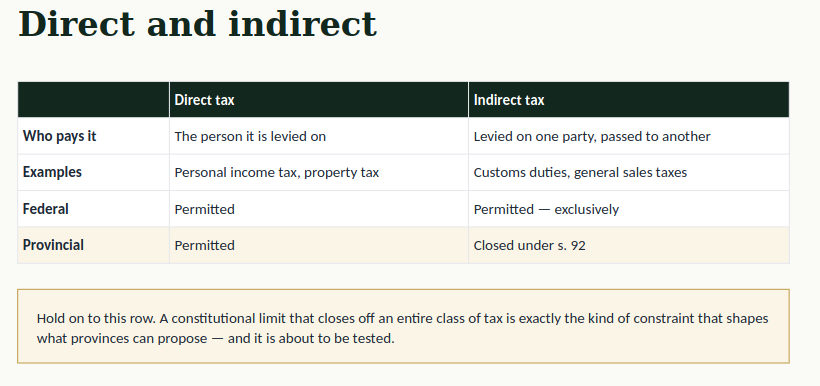
- direct or indirect - and indirect exclusively
- any mode or system of taxation
- the main subjects
- defence: navigation and shipping
- trade and commerce
- criminal law
- money, banking, and currency
- what else
- POGG: everything not on the other list
- plus the power to borrow when revenues fall short
- POGG: everything not on the other list
- provincial
- taxing power
- indirect taxation is closed to them
- the main subjects
- health - education - social services
- muncipalities - administration of justice
- property and civil rights
- what else
- section 125 shields each order’s lands from the other
-
-
note: a constitutional limit that closes off an entire class of tax is exactly rhe kind of constraint that shapes what provinces can propose - and it is about to be tested.
what came with the money
- ottawa took on responsibilities that sat with the colonies - the stuff the federal government takes care of
- also assumed the existing debts of the provinces - servicing and repayment both
- federal debt was about 25 percent of GDP at confederation
- taking on the provinces debts is why revenue asymmetry looked reasonable in 1867
- obligations moved with the money - at the time
the mismatch
- the order of government with the broad, open ended revenue power is not the order carrying the heavy obligations
- ottawa can raise money by any mode or system of taxation
- own responsibilities - defence, trade, commerce, criminal law, money, and banking - are not the ones that consume modern budgets.
- provinces held to direct taxation within the province, and hold social services.
- they do not line up, and nothing in the constitution makes them line up.
- nothing has ever repaired this: managing it is what fiscal federalism means
- ottawa can raise money by any mode or system of taxation
- the order with the money is not the order with the obligations
- everyone runs on deficits: in what sense does ottawa have money?
- debt-to-gdp ratio: does the debt grow faster than the economy, indefinitely, under current policy
- on this test, the parlimentary budget officer finds federal policy sustainable: ~ 1.8% GDP in the room, or 46
- princes and territories as a group: sustainable, but with essentially no room. several not individually sustainable.
- driver is health spending as the population ages
- debt-to-gdp ratio: does the debt grow faster than the economy, indefinitely, under current policy
- fiscal capacity: the ability to raise revenue, not the cash in hand
- equalization defined on this term
power of the purse
- expensive business of the government was federal
- defence, canals, and railways, and debts of the colonies
- what we asked the government to do changed
- the functions we came to care about more changed: education, healthcare, income support
- federal spending power:
- ottawa can spend in areas it cannot legislate in, and attach conditions
- cannot set tuition
- can give funding to provinces and say what the money is for
- ottawa can spend in areas it cannot legislate in, and attach conditions
- money is a way of legislating in someone else's jurisdiction
- the deal, whole
- colonies hand over their main revenue source - ottawa assumes their debts and takes the national responsibilities
- provinces keep health, education, social services -with direct taxation only
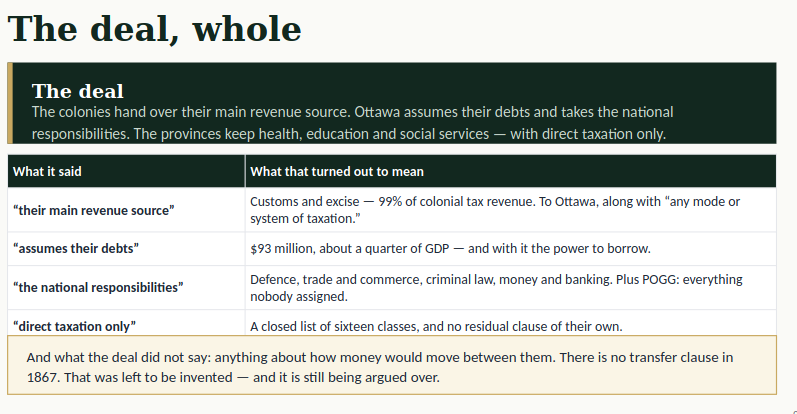
- colonies hand over their main revenue source - ottawa assumes their debts and takes the national responsibilities
what 1982 changed
- patriation: made in canada procedure that meant asking the parliment of the united kingdom to pass a statute, brought the power home
- patriation had been tried and failed since the 1920’s
- nobody could agree on how a patriated constiution would be changed
- what broke the deadlock was QB
- pierre trudeau promised renewal if the 1980’s sovereignty refernum failed
- it did, and he carried good on his promise
- produced section 35, and [[the amending formula]]
- pierre trudeau promised renewal if the 1980’s sovereignty refernum failed
- alberta and SK got a different grievance: a decade of fights over who got the resource revenue
- national energy program in 1980: lougheed and blakekey led provincial negotiation, price was section 92A
- section 92A - the resource amendment = was the only part of the whole patriation package that changed division of powers between the two orders of government
- how did this change powers?
- the charter is what 1982 is remembered for. section 92a is what it did to public finance.
- grievance that produced it is the one on the ballot on oct. 19.
- read section 92a against section 92
- provinces held to direct taxation only - except on resources, where they get the same privileges as ottawa as far as indirect taxation goes
- alberta’s royalty regime lives in that exception
- provinces held to direct taxation only - except on resources, where they get the same privileges as ottawa as far as indirect taxation goes
- patriation had been tried and failed since the 1920’s
the constraint bends
- the direct/indirect line is the only thing standing between a province and an entire class of tax
- it comes up every time a province wants a revenue source it does not obviously have
- never settled be economics
- economics asks who bears the burden - a court asks something else, and the court’s answer is the one that governs
- there have only ever been two ways out:
- move the line: get a court to call the tax you want a diret one; this is how the provincial sales taxes exist
- move the money: leave the line alone, ottawa raises the revenue and hands it to the provinces. that is transfers.
- ---> slide 127